
Insights
Model-Informed Design of Oral Controlled Release Products in Early Proof-of-Concept Studies
Claire Patterson, Director of Complex Medicines at Seda Pharmaceutical Development Services provides an insight into the considerations and benefits of model-informed dosage form design. For those companies considering early proof-of-concept studies this article is a useful guide when planning studies and considering the selection of suitable service providers to support them.
Introduction
In early-phase drug development, particularly for oral controlled release (OCR) dosage forms, achieving the right pharmacokinetic (PK) profile is essential to demonstrating proof-of-concept (PoC). Outsourcers navigating this phase are not only seeking clinical validation - they're also laying the groundwork for scalable, manufacturable products. In this regard, model-informed development approaches have the potential to integrate PK modelling with formulation design, enabling smarter decisions, faster timelines, and reduced risk.
This article explores how modelling can be used to guide OCR product design, from initial data interpretation to formulation optimisation and GMP readiness and supply.
From Data to Design: Using PK Modelling to Inform OCR Strategy
1. Starting with Immediate-Release
Data
A combination of in vitro physchem and
ADME data plus early PK data from animal
and human studies using
immediate-release (IR) formulations
provide a foundation for modelling.
These data help define human PK
parameters and exposure targets and
identify limitations such as short
half-life or high Cmax. These data
anchor the modelling process, helping
identify where controlled release could
improve therapeutic performance or
mitigate safety risks.
2. Defining Optimal Release
Profiles Through Simulation
Using compartmental or physiologically
based PK (PBPK) models, it is possible
to simulate alternative release profiles
to meet target product profiles (TPPs).
These simulations help flatten Cmax to
reduce peak-related toxicity, extend AUC
to maintain therapeutic levels over
time, and target regional delivery
(e.g., colon for IBD). The modelling
guides formulation strategy - whether
extended-release, enteric-coated, or
colon-targeted—and helps prioritise
technologies such as matrix systems,
coated pellets, or multiparticulates.
3. Formulation Composition: Linking
Design and Performance
Once a target release profile is
defined, modelling can be used to
evaluate how close prototype
formulations are to the desired
performance. In vitro dissolution data
(biorelevant media, volume-limited
conditions) are integrated into the
model. Sensitivity analysis identifies
critical formulation parameters such as
polymer type, coating thickness, and
excipient ratios. Iterative refinement
ensures alignment with predicted in vivo
behaviour. This approach reduces the
need for empirical trial-and-error and
accelerates formulation lock for GMP
scale-up.
4. Post-FIH Optimisation: Learning
and Refining
Once OCR products enter human studies,
models can be further refined using
observed clinical data. Model validation
is performed against observed PK
profiles. Adjustments to release
kinetics are made based on food effects,
variability, or unexpected absorption
patterns. Scenario testing supports dose
adjustments, bridging studies, or
formulation tweaks. This iterative
learning builds confidence in the
product and supports regulatory
interactions, tech transfer, and
commercial planning.
Strategic Impact for Outsourcers
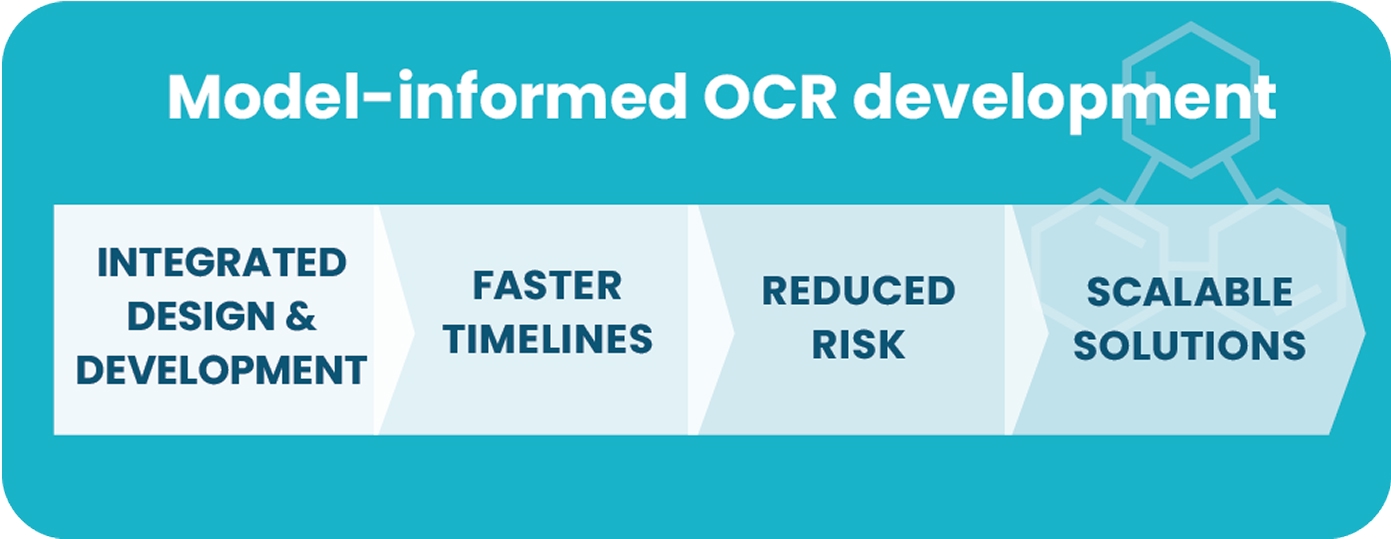
Model-informed OCR development offers outsourcers integrated design and development, faster timelines (PoC in 6-9 months versus 12-18 months with empirical approaches), reduced risk through early identification of formulation liabilities, and scalable solutions designed with manufacturability and regulatory success in mind.
Conclusion
Pharmacokinetic modelling is more than a predictive tool - it's a strategic driver of product design. An integrated approach combining modelling with experimental iteration ensures that OCR formulations are not only clinically effective but also commercially viable. By aligning modelling with formulation science and development milestones, outsourcers can make smarter decisions, build stronger teams, and deliver successful PoC outcomes with confidence.

Seda Pharmaceutical Development Services provide modelling, dosage form design and clinical trial supply services supporting development companies from discovery, through early clinical trials and onwards to product approval.